
Reviewed · WINE TOURS
Full Day Tbilisi City Tour with Wine Tasting & Cable Car Ride
Tbilisi packs a lot into one day. I really like the private transportation that keeps transfers smooth, and the Georgian wine tasting that makes the day feel properly local. One thing to consider up front, this route is walking-heavy with stairs, and church dress rules can slow you down if you are not prepared.
This is a 9-hour, English-speaking private tour that starts at 9:00 am with pickup offered. You will see major sights across town, spend time in Old Town, ride included cable options, and end with a restaurant and museum show. Alcohol is included, but Georgia’s legal drinking age is 18, so if you are under that, you will want to skip the pours and stick to water.
In This Review
- Key highlights at a glance
- How the full-day Tbilisi loop is set up to keep you moving
- Chronicles of Georgia and Holy Trinity Cathedral, big symbols first
- Old Town Tbilisi, Metekhi, and the walkable soul of the city
- Mtatsminda Park funicular: optional views, not included
- Cable ride to Mother of Kartli and Narikala Fortress views
- Sulphur Bath area and Leghvtakhevi Waterfall, a fun break from churches
- Sioni Cathedral and Jvaris Mama Church, plus the detail people often miss
- Rezo Gabriadze Puppet Theater, Tamada statue, and Anchiskhati Basilica
- Bridge of Peace and the folk dance restaurant finale
- Price of $147.50: what feels like value, what might not
- Who this tour fits best, and who should reconsider
- Should you book this full day Tbilisi city tour?
- FAQ
- What time does the tour start?
- How long is the Tbilisi city tour?
- Is pickup offered?
- What language is the tour guide?
- What is included in the price?
- What is not included?
- Do I need special clothing for churches?
- Is there any drinking age rule to know about?
- Is the cancellation free if I change my plans?
Key highlights at a glance
- Church and cathedral stops that explain modern Georgia’s roots plus the big Orthodox symbols you will see everywhere
- Cable rides with serious views, including the Mother of Kartli and Narikala Fortress area
- Georgian wine tasting tied to a real meal, not just a quick sip-and-run
- Old Town walking time where you can actually see how neighborhoods and churches sit on the river and hills
- An evening-style finale with traditional dance and singing, at a restaurant and museum setting
More Wine Tours in Tbilisi
- Day Trip to Kakheti Wine Region Including 9 Wine Tastings★ 5.0 · 2,774 reviews
- From Tbilisi: Kakheti Wine Region Tour with 9 Wine Tastings★ 4.9 · 2,541 reviews
- Tbilisi: Kakheti Wine Region Tour with 10 Wine Tastings★ 5.0 · 2,160 reviews
- Tbilisi: Mtskheta Jvari Bazaar, Chronicles of Georgia & Wine★ 5.0 · 1,088 reviews
How the full-day Tbilisi loop is set up to keep you moving
This tour is designed for people who want the highlights without spending your whole day in taxis. You get air-conditioned vehicle transport between areas, plus bottled water, and the pace is built around time blocks at each major stop. That means fewer “How do we get there?” moments and more “Okay, wow” moments.
The itinerary also has a smart mix of viewpoints, churches, and a couple of more unusual stops. You do not just grind through cathedrals. You get the fortress views, the sulphur waterfall area, and a show with Georgian music and dancing at the end.
The small catch is that the day is long. The walking in Old Town includes uneven ground and stairs, so comfortable shoes are not optional. Also, Orthodox churches require headscarves and dresses for women, and short trousers for men are forbidden. Scarves and dresses are available near church entrances, but you will still want to bring something simple and easy to manage.
Chronicles of Georgia and Holy Trinity Cathedral, big symbols first
You start at the Chronicles of Georgia monument, a standout for anyone who likes monuments that tell a story. The site is built around 16 pillars that are 30 to 35 meters tall. The upper parts show kings, queens, and heroes, while the lower areas depict scenes connected to the life of Christ. There is also a grapevine cross of St. Nino and a chapel, so it hits both religious and national imagery in one place.
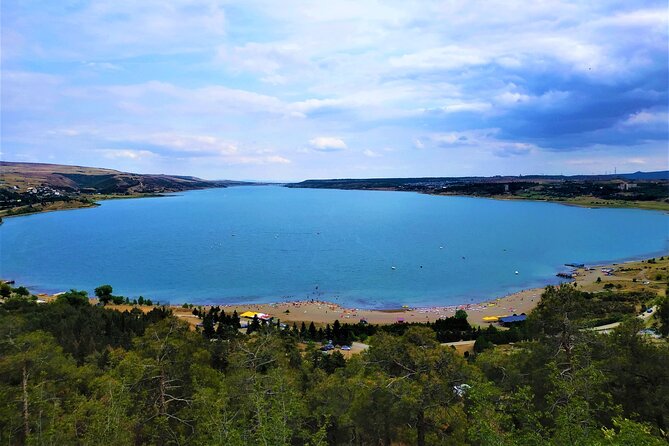
Why it matters for your day: it gives you a framework. After you see the pillar storytelling, the rest of the churches and historical references feel less random. Plus, the views over the Tbilisi Sea area help you orient yourself for the city’s shape.
Next comes Tbilisi’s Holy Trinity Cathedral, the main cathedral of the Georgian Orthodox Church, built between 1995 and 2004. It commemorates 1,500 years of autocephaly for the Georgian Orthodox Church and 2,000 years from the birth of Jesus. It is also one of the largest Eastern Orthodox cathedrals by total area, and it is the third-tallest in the tradition.
Practical note: both these stops have free admission and good photo opportunities. You will still want to dress properly early, because once you start stacking church visits back to back, it gets harder to improvise.
Old Town Tbilisi, Metekhi, and the walkable soul of the city
Old Town Tbilisi is where you start to feel the city’s layers. Tbilisi sits on the banks of the Kura River and was founded in the 5th century AD by Vakhtang I of Iberia. Because it sat on the crossroads between Europe and Asia, and near the Silk Road trade routes, it was pulled into power struggles again and again. That long history shows up in the architecture, from medieval shapes to neoclassical and Art Nouveau influences, plus Stalinist and modern buildings.
This stop is scheduled for about 3 hours, and that time is key. You get enough space to wander rather than just stop, snap a photo, and move on. You will be on foot, and terrain can include stairs and uneven sections, so pace yourself.
Then you visit Metekhi Cathedral of the Assumption, built by St. Demetrius II in the 13th century. It has had a rough history of damage and restoration. Under Russian rule starting in 1801, the church lost its religious role and was used as a soldier base. Later, a citadel was demolished and replaced with a jail that stayed until the Soviet era. There is also a statue of King Vakhtang Gorgasali set up in 1961.
Why this stop feels different: it reminds you that the church buildings you see today were not always sacred. They have survived wars, regime changes, and repurposing, yet the spiritual presence returns each time.
Mtatsminda Park funicular: optional views, not included
Mtatsminda Park sits at about 770 meters above sea level and is described as the highest point of Tbilisi. The funicular line itself is 501 meters long, with an angle around 28 to 33 degrees. This is the moment when you can add a classic uphill ride for extra panorama.
Important for planning: the funicular ride is not included, with the cost listed at around $7 per person. If you are budgeting tightly, you can decide here whether you want to spend extra money for that specific ride.
Also, remember that you will already have included cable car time later in the day. If you are the type who wants fewer transfers and fewer tickets, you might prefer to save your energy and keep only the included tramway portion.
Still around Tbilisi? These come up often:

Cable ride to Mother of Kartli and Narikala Fortress views
This is one of the most scenic parts of the day. You take an aerial cable car to the Mother of Kartli monument, erected in 1958 for Tbilisi’s 1500th anniversary. The monument is a 20-meter aluminum figure designed by Elguja Amashukeli. She is dressed in national clothing and she holds a bowl of wine in her left hand, greeting friends. In her right hand she holds a sword for enemies.
What you should expect: big city views and a quick hit of national symbolism. The gesture details matter here because you will see “wine and hospitality” show up again later in the day with the wine tasting and meal.
After that, you go to Narikala Fortress, originally established as a 4th-century Sasanian citadel called Shuris-tsikhe. King David the Builder expanded it in 1089 to 1125. The Mongols renamed it Narin Qala, meaning Little Fortress. Some of the most visible fortifications date to the 16th and 17th centuries, and there was an earthquake damage event in 1827.
Why this is a value add: you get the city and the historical context in one go. Many tours do only one or the other. Here, the viewpoint makes the old fortifications make sense.
Sulphur Bath area and Leghvtakhevi Waterfall, a fun break from churches
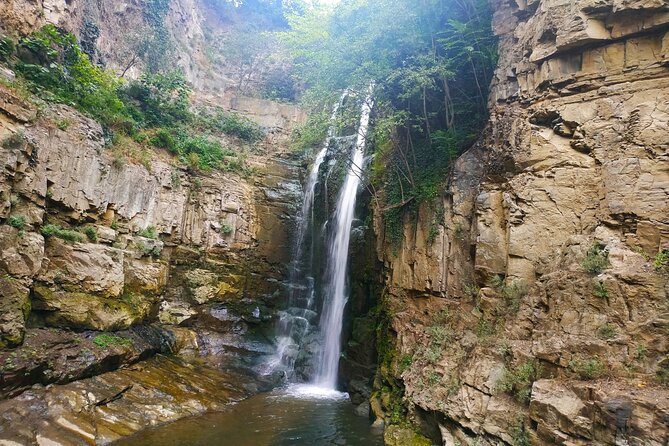
After fortress views, the tour heads to the sulphur area connected with the sulphur baths and Leghvtakhevi Waterfall. Sulphur baths are described as thermal springs coming from the ground at about 40 to 50°C, and the info lists potential benefits for skin problems, dry scalp, arthritic joints, digestion problems, and insomnia.
Even if you do not plan to soak, this stop gives you a different Tbilisi vibe. It is more nature and atmosphere than monuments. You also get to see the Love Lock Bridge and then the Leghvtakhevi Waterfall, which is said to flow from a botanical garden.
Practical consideration: this section is shorter, so it is best treated like a reset. If your feet are feeling it, use the time to slow down, take photos, and hydrate.
Sioni Cathedral and Jvaris Mama Church, plus the detail people often miss
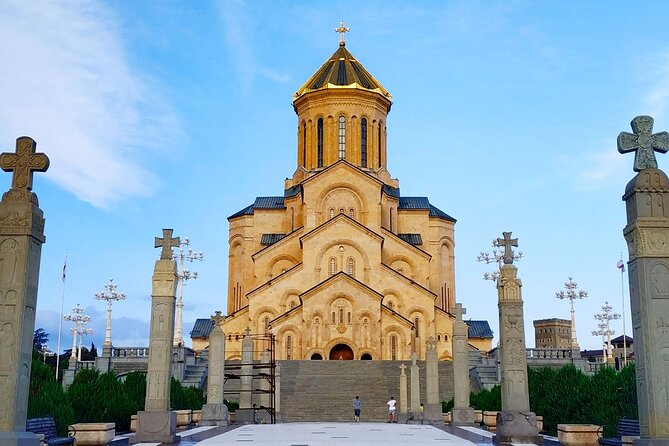
Sioni Cathedral is tied to Mount Zion in Jerusalem. It began as a 6th to 7th century church and was destroyed by foreign invaders multiple times before being reconstructed. The current structure is based on a 13th-century version with later changes from the 17th to 19th centuries, and it was rebuilt completely by King David the Builder in 1112.
Then you move to Jvaris Mama Church. The tour explains that King Vakhtang Gorgasali built a saint cross church in the 5th century called Golgotha, tied to legend about St. Nino living there. The current building dates to the 16th century but was destroyed several times. It was restored in the 1990s and is described as a church of the Chapelhall type. There is also a note that until 1921, the Father of Cross church belonged to the Jerusalem patriarchy and funded the Georgian chapel church for centuries, which is why it is noted as cold.
This is one of those moments where taking 20 minutes seriously pays off. If you pay attention to inscriptions, layout, and the way these churches sit in the neighborhood, you start to understand how Orthodox symbolism is embedded in everyday city life.
Rezo Gabriadze Puppet Theater, Tamada statue, and Anchiskhati Basilica
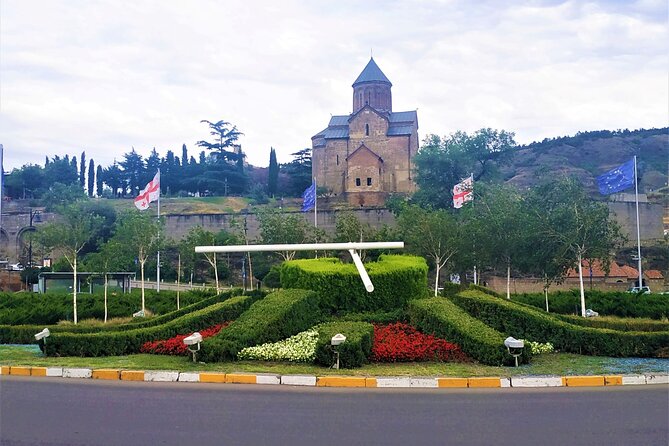
This part of the day mixes humor and old stone in a surprisingly effective way. You walk past the Leselidze street area and see the Tamada statue, then you visit the Rezo Gabriadze Puppet Theater.
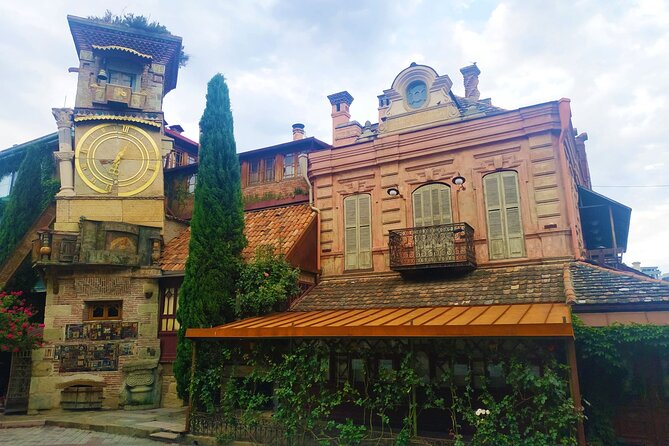
Rezo Gabriadze is described as a theatre and film director, writer, painter, and sculptor, born in 1936. The theatre was founded in 1981. One of the most specific details here is the clock tower, added in 2011. On the hour, a window opens and a mannequin of an angel strikes the bell. Under the clock, a screen opens and shows a sequence of life events: boy meets girl, marriage, childbirth, and funeral.
Why it works: it breaks the church-and-fortress rhythm with something modern, playful, and very Georgian in its own style.
Then you visit Anchiskhati Basilica of St. Mary, described as the oldest surviving church in Tbilisi, built in the 6th century by King Dachi. It was originally dedicated to the Virgin Mary but was renamed Anchiskhati in 1675 when a treasured icon created by 12th-century goldsmith Beka Opizari, originally kept at the Ancha monastery in Klarjeti, was moved to Tbilisi to protect it from Ottoman invasion. The icon is now at the Art Museum of Georgia.
If you only remember one thing from this section, remember that a building is not just architecture. It is also about objects, names, and protection of sacred items across centuries.
Bridge of Peace and the folk dance restaurant finale
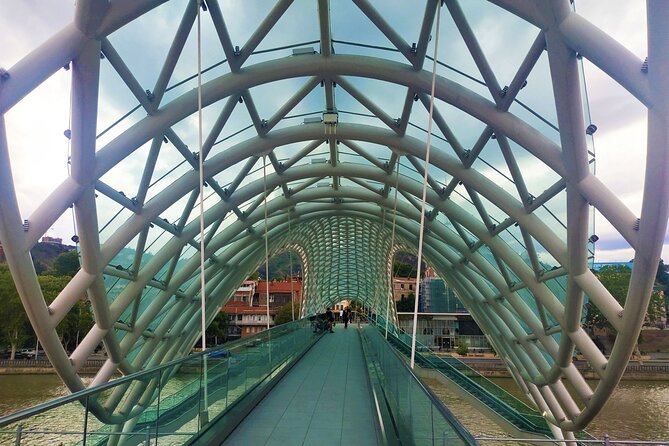
You finish with the Bridge of Peace and Rike Park. The bridge opened in 2010 and is about 150 meters long, designed with marine animal motifs. It was designed by Italian architect Michele De Lucchi, who is also credited with designing the Presidential Palace and the Ministry of Internal Affairs of Georgia.
You also get an option for a boat tour on the river Mtkvari, but that is an additional charge. If you are short on energy, you can still enjoy the bridge and park views without it.
The grand finale is food and performance. The tour includes a transfer to a luxury Georgian restaurant and museum with traditional dancing and singing shows. This is where the day’s theme clicks into place: wine, hospitality, and celebration. It is also a practical way to end without scrambling for dinner reservations in a city where timing can be everything.
One more note: alcohol beverages are included, and Georgia’s legal drinking age is 18. If you want to pace yourself, water is included too, so you can do both.
Price of $147.50: what feels like value, what might not
At $147.50 per person, you are paying for a full day with private transportation, air-conditioned comfort, bottled water, and included alcohol. The itinerary also stacks mostly free admission stops, and the included cable car time and time with a set lunch plan reduce planning stress.
Here is where the value depends on you:
- If you hate logistics, private driver transport between locations is worth a lot. You avoid the mental load of figuring out connections across hills and neighborhoods.
- If you love viewpoints, the included aerial tramway segment plus the Narikala Fortress stop can justify the price even without thinking about every admission.
- If you are not into wine or do not drink, you may feel like you are paying extra for the alcoholic beverages. That said, the wine tasting and included meal are still part of the cultural experience.
The only clearly listed extra cost is the funicular ride, around $7 per person. Everything else is marked free admission or included where stated, which helps you forecast your total day cost.
Who this tour fits best, and who should reconsider
This is a great fit if you want a structured day that covers the major icons of Tbilisi plus a couple of off-beat cultural moments like the puppet theatre. It is also a good choice if you do not want to worry about how to get from fortress views to Old Town churches to the river bridge.
You might reconsider if:
- You have limited mobility, since the day includes Old Town walking with stairs and uneven terrain.
- You are very picky about guide quality. One review flagged that private tours in Tbilisi can be hit or miss on guidance style and approach, so if you care a lot, ask direct questions early in the day.
Should you book this full day Tbilisi city tour?
If your goal is to see a lot of Tbilisi in one day without wrestling transit, I think booking makes sense. The combination of included cable ride time, the wine tasting with a meal, and the end-of-day folk show gives you variety, not just church photos.
Book it if you are comfortable walking, can follow church dress rules, and want a planned route with minimal effort. Skip or adjust if funicular extras and a long day sound like too much, or if you want total freedom to wander slowly at your own pace.
FAQ
What time does the tour start?
The tour starts at 9:00 am.
How long is the Tbilisi city tour?
It runs about 9 hours.
Is pickup offered?
Yes, pickup is offered.
What language is the tour guide?
The tour is offered in English.
What is included in the price?
The tour includes private transportation, an air-conditioned vehicle, alcoholic beverages, bottled water, a lunch stop in a restaurant, and wine tasting. It also includes the aerial tramway segment to Mother of Kartli and the Narikala Fortress visit.
What is not included?
The funicular ride in Mtatsminda Park is not included, and it is listed at around $7 per person.
Do I need special clothing for churches?
Yes. In Georgian Orthodox churches, women need head scarves and dresses, and short trousers for men are forbidden. Scarves and dresses are available near church entrances.
Is there any drinking age rule to know about?
Yes. The legal drinking age in Georgia is 18.
Is the cancellation free if I change my plans?
Yes, you can cancel for free. You can cancel up to 24 hours in advance for a full refund, and poor weather can also lead to a refund or a different date.
More Full-Day in Tbilisi
- From Tbilisi: Kutaisi Canyons and Caves Full Day Tour
★ 4.8 · 1,051 reviews - Kutaisi Canyons and Caves from Tbilisi Full Day Tour
★ 5.0 · 448 reviews - Kazbegi and Gudauri Full Day Private Tour from Tbilisi
★ 5.0 · 447 reviews - Full Day Private Wine Tour in Kakheti Region with Lunch and 3 Wine Tastings
★ 5.0 · 207 reviews
Other Food Tours in Tbilisi
- Tbilisi:Mtskheta,Jvari,Bazaar,wine tasting,Chronicles of Georgia
★ 5.0 · 730 reviews - Old Tbilisi Tour: Private Walking Tour With Wine Tasting
★ 5.0 · 273 reviews - Private Tbilisi Food Tour: 9 Tastings Walk in Bohemian District
★ 5.0 · 227 reviews - Tbilisi Food Tour in a Local Family
★ 5.0 · 113 reviews
Newer trips around Tbilisi
- Tbilisi Private Dinner: Georgian BBQ & Fireplace
★ 5.0 · 1 review - Tbilisi: Khinkali Tasting Lunch with Local Drinks and Pickup
★ 5.0 · 1 review - Day trip in Kakheti-wine tour
★ 5.0 · 1 review - Tbilisi & Mtskheta bus tour hop on hop off
★ 5.0 · 1 review - Tbilisi: Christmas Market & Hidden Gems Guided Walking Tour
★ 5.0 · 1 review - Stalin’s Secrets: An Underground Journey Through History
★ 5.0 · 1 review
Wine Tours, compared.
Day Trip to Kakheti Wine Region Including 9 Wine Tastings
Read our review →
Kakheti Wine Region Tour with 9 Wine Tastings
Read our review →
Kakheti Wine Region Tour with 10 Wine Tastings
Read our review →
Mtskheta Jvari Bazaar, Chronicles of Georgia & Wine
Read our review →
Kakheti Wine Region: Signagi and Bodbe Tour with 10 Wine Tastings
Read our review →
Mtskheta,Jvari,Bazaar,wine tasting,Chronicles of Georgia
Read our review →
Evening Walking & Talking Tour with Wine & Boat Ride
Read our review →
Evening Walking Tour with Wine & Boat Ride Options
Read our review →Browse the lists this tour appears in