

Reviewed · WALKING TOURS
Private Walking Tbilisi City Tour (Day Trip)
Tbilisi gets under your skin on foot. This shared city walk strings together Old Tbilisi views and the capital’s multi-faith heritage, with a guide who explains what you are actually looking at. I like that you are not just sightseeing, you are getting the why behind the places, from fortresses to cathedrals.
Two things I really appreciated: the professional guide service (several guides are named in feedback, like Teimuraz and Temo) and the smart pace that lets you see a lot without feeling rushed. The one thing to consider is that transportation is not included, so you will need to get yourself to the start and plan for a true walking day.
In This Review
- What you really get from this 6 to 7 hour Tbilisi walk
- Narikala Fortress area, the view-first entrance to Old Tbilisi
- The sulphur bath legend and a quick look at warm-water Tbilisi
- Rustaveli Avenue, where you see 20th century Tbilisi thinking
- Abanotubani and the historic hot springs core
- The Great Synagogue of Tbilisi and the multi-faith route logic
- Metekhi Cathedral and the palace-area meaning of the name
- Bridge of Peace, Rike Park, and that Georgia symbol statue
- Anchiskhati Basilica and Sioni Cathedral, two key Orthodox anchors
- Leselidze street, Rezo Gabriadze marionette theater, and the city’s playful side
- Leghvtakhevi sulphur waterfall, a last stop that feels like a twist ending
- Price, value, and who this walking tour fits best
- Should you book this Tbilisi city tour?
- FAQ
- How long is the Private Walking Tbilisi City Tour?
- Is transportation included in the price?
- What language is the tour offered in?
- Does the tour include bottled water?
- Is the tour a private or shared experience?
- Are there admission tickets included?
- Where does the tour start and end?
- Do I need a ticket app or mobile ticket?
- What happens if the weather is bad?
What you really get from this 6 to 7 hour Tbilisi walk
- Narikala Fortress area gives you sweeping views plus key early landmarks nearby, including ancient churches
- Multi-faith stops in one route, from Jumah Mosque and the Great Synagogue area to Orthodox sites
- Central and modern contrast on Rustaveli Avenue, then back into Old Tbilisi
- Bridge of Peace and Rike Park for modern Tbilisi culture and photo-worthy river views
- Small but memorable diversions like the marionette theater and the 22 meter sulphur waterfall area
- Bottled water included so you can keep moving without hunting for refills
More Day Trips in Tbilisi
- Tbilisi: Day Trip to Kazbegi, Gudauri, Gergeti, and Ananuri★ 4.9 · 3,203 reviews
- Day Trip to Kakheti Wine Region Including 9 Wine Tastings★ 5.0 · 2,774 reviews
- Day Trip to Kazbegi and Gudauri★ 5.0 · 2,009 reviews
- Day Trip to Mtskheta Gori and Uplistsikhe★ 5.0 · 1,801 reviews
Narikala Fortress area, the view-first entrance to Old Tbilisi
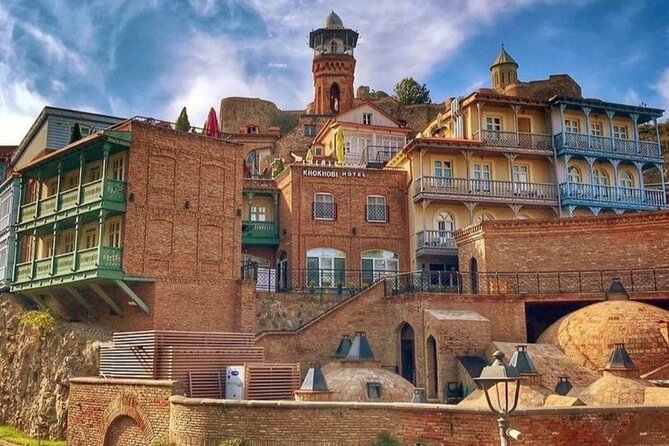
You start in the Narikala Fortress area, and that is a good call. This is where the geography hits you. From up here, Tbilisi reads like layers, stone stacked on stone, with winding streets folding down toward the river.
Time-wise, this segment is the longest (around 50 minutes). That matters, because you get breathing room to orient yourself. You will also see the kinds of religious landmarks that define this part of the city: the Anchiskhati church dating to the 6th century sits in the same general zone, and the area includes nearby Christian sites plus both Muslim and Jewish heritage points. Even if you do not go inside every building, just having them grouped in your route helps your brain connect the dots.
Practical note: wear comfortable shoes. Narikala is not about flat strolls, and this tour is built for walking. Also, you will be on a shared schedule, so expect the group to keep together.
The sulphur bath legend and a quick look at warm-water Tbilisi
From the fortress views, the tour shifts down toward the sulphur bath story, and this is where the city’s name becomes more than trivia. In Tbilisi legend, the warm mineral springs are tied to King Vakhtang Gorgasali. Here, the tour also points out the sculpture view from the Metekhi plateau toward the famous bath area, so you can see how the city’s layout supports the legend.
This stop is shorter (about 30 minutes), and the entry is listed as free. What you get is time to understand the theme: Tbilisi is literally built around warmth, steam, and water that changes the way locals used everyday life. If you have ever wanted to understand why Tbilisi feels different from other Caucasus cities, this is one of the clearest answers on the route.
Possible drawback: if you are expecting a full spa session, this is not that kind of stop. The tour is focused on sights and context, not booking an extended bath experience. Plan accordingly.
Rustaveli Avenue, where you see 20th century Tbilisi thinking
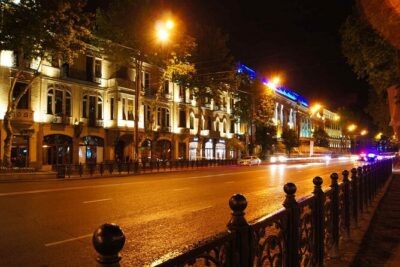
Then you swing to Rustaveli Avenue, and it is a nice change of pace. This is the cultural spine of the newer part of the city, and the route is designed so you see the contrast without losing the Old Tbilisi story.
You will pass major landmarks such as the Drama Theater named after Rustaveli and the State Academic Theater of Opera and Ballet named after Zakaria Paliashvili. You also get glimpses of older education and salon-style spaces, which helps explain why this avenue feels both formal and creative.
This segment runs about 1 hour, and that length is useful. It gives you time to slow down, look up at façades, and connect what you saw earlier in the fortress area to what the city built later. You are not just moving locations, you are watching Tbilisi grow.
Abanotubani and the historic hot springs core
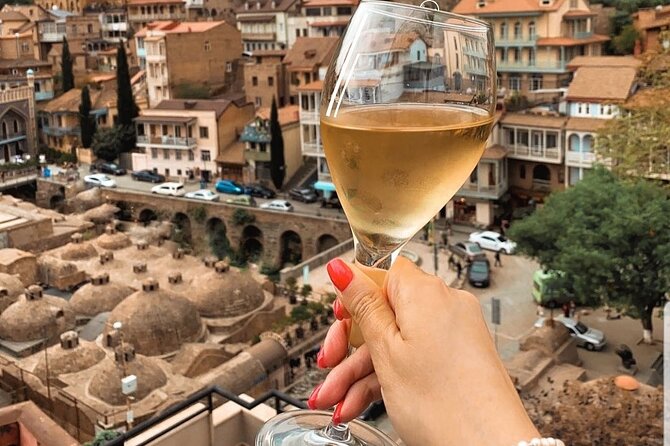
Back into Old Tbilisi territory, the tour heads to Abanotubani, the historic bath district. The legend here is straightforward and satisfying: a falcon falls, the hot springs are discovered, and the capital begins again around that warmth.
This stop is brief (about 15 minutes), but it has a specific value. It anchors the earlier sulphur bath story in a place you can actually visualize. You will also likely recognize why Abanotubani is so photographed. The architecture and steam atmosphere are part practical, part theatrical, and it is one of those zones where you feel the city’s daily rhythm even in a short visit.
If the weather is cold or rainy, this area can feel even more atmospheric. Bring a jacket. If it is hot, you will appreciate that bottled water is included for the whole group.
More walking tours in Tbilisi:

The Great Synagogue of Tbilisi and the multi-faith route logic
One of the best ideas in this tour is how it threads religious history into a single day. You do not treat faith as a museum wing. You see it as part of the city’s living geography.
At the Great Synagogue of Tbilisi, also known as the Georgian Synagogue, you will learn that it was built from 1895 to 1903 in an eclectic style by Georgian Jews from Akhaltsikhe who migrated to Tbilisi in the late 19th century. There is a lot packed into that timeline, and the stop (about 15 minutes) is timed to give you enough context without killing the day.
What I like here is that it is not only about buildings. It is about community movement, migration, and how Tbilisi became a crossroads. If you want a Tbilisi experience that feels thoughtful, not just checklist tourism, this is one of the reasons.
Metekhi Cathedral and the palace-area meaning of the name
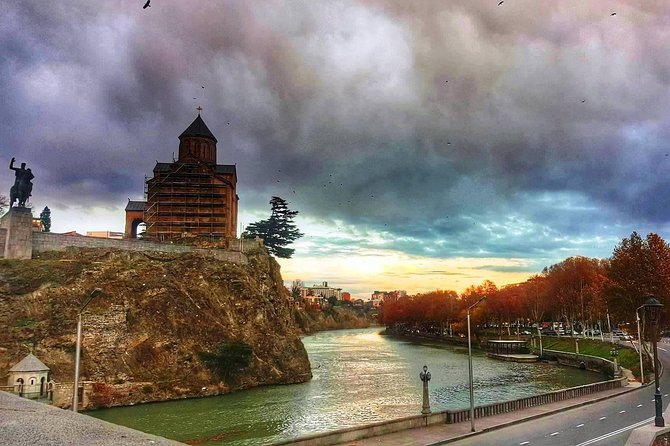
Next is Metekhi Cathedral. This is one of those locations where the story sticks because you can feel it in the placement.
The tour explains that King Vakhtang I Gorgasali erected a church and a fort here, and it also served as a king’s residence. The name Metekhi goes back to the 12th century and literally refers to the area around the palace. That language clue matters. It makes you look at the space differently, like a map of power rather than just a photo spot.
This stop is about 15 minutes, with no admission listed. Even so, it helps you connect earlier fortress viewpoints to later religious landmarks. You are building a mental model of Tbilisi’s layers: rule, faith, city life, and then the modern city expanding outward.
Bridge of Peace, Rike Park, and that Georgia symbol statue
After the older religious and fortress points, the tour moves into a modern arc along the river. You will stop at the Bridge of Peace, constructed between 2009 and 2010. The design is credited to Italian architect Michele De Luci, and the lighting system is by French Philip Martino. You will also likely get enough time (about 15 minutes) to take in how the bridge reshaped views and movement here.
Then comes Rike Park, where festivals like Tbilisoba happen. This is a quick stop (about 15 minutes), but it is a useful reminder that parks and public spaces are not filler on a tour. They are where the city performs for itself.
Right after, you will see Kartlis Deda, the symbol of Georgia: a statue that meets friends with wine and enemies with a sword. Again, the stop is short (around 15 minutes), but this statue is so central to Georgian visual identity that you will feel like you finally understand why you have been seeing it referenced elsewhere.
Anchiskhati Basilica and Sioni Cathedral, two key Orthodox anchors
Back to churches, and these are not random stops. Anchiskhati Basilica is listed as the oldest of surviving churches in Georgia, dating to the 6th century. You will also hear that an art studio connected to sculptor Elguja Amashukeli created the symbol of Georgia, Kartlis Deda. That is a clever link between a church stop and the statue you just saw.
This stop is about 15 minutes. That is just enough time to grasp significance and take in the setting without turning into cathedral fatigue. If you like architecture and symbols, this is a strong pairing.
Then the tour heads to Sioni Cathedral, built in the 6th and 7th centuries, destroyed over time, and reconstructed multiple times. The current church is based on a 13th-century version, with changes from the 17th to 19th centuries. You also learn it was the main Georgian Orthodox Cathedral and seat of the Catholicos-Patriarch of All Georgia until the Holy Trinity Cathedral was consecrated.
This is a lot of timeline in a short stop (about 15 minutes), so do yourself a favor: listen closely the first time. If you want to re-check details later, you will know what to search for.
Leselidze street, Rezo Gabriadze marionette theater, and the city’s playful side
Between the grand buildings, the tour gives you human scale. Leselidze is described as a street combining old and new parts of the city. This is one of those stops where you are basically training your eye. You can see how Tbilisi keeps building, yet still carries its older streets forward.
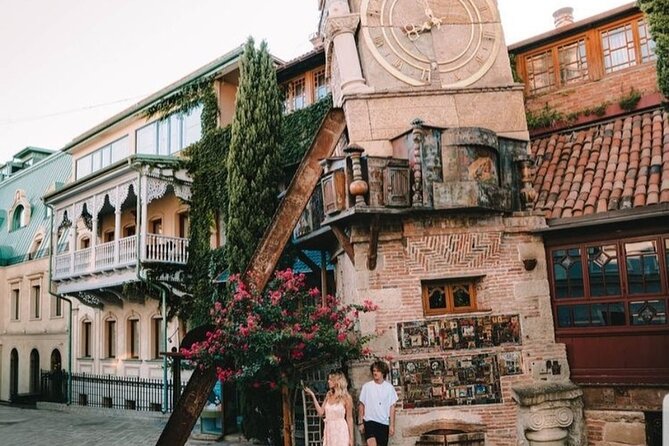
Then comes Rezo Gabriadze Marionette Theater, one of Tbilisi’s most recognizable sights. The tour notes that there is a show every day, and the performance is described as having depth and soul that is world popular. Even if you just spot the building on your walk, you start to understand how Tbilisi treats art as daily life, not a once-a-year special event.
This stop is about 10 minutes. That is short, but it works because it prevents the day from becoming all stone and centuries. It adds a little breath before the final Old Tbilisi finale.
Leghvtakhevi sulphur waterfall, a last stop that feels like a twist ending
The tour ends with the Dzveli Tbilisi sulphur waterfall area, called Leghvtakhevi. It is listed as a 22 meter tall waterfall. The name Leghvtakhevi connects to the Georgian word leghvi, meaning fig, because there were many fig trees around the area.
What makes this a strong final stop is that it shifts the focus from buildings to nature and water. After cathedrals, synagogues, and bridges, the day ends with something physical you can feel and picture. It is the kind of ending that makes your photos make sense as a story.
This stop is about 20 minutes and is also listed as free. One practical tip: keep your phone protected if it is wet out. Waterfalls bring mist.
Price, value, and who this walking tour fits best
At $59 per person for 6 to 7 hours, this tour is priced like a solid budget-to-midrange day. The biggest value booster is that it includes a professional guide plus bottled water, and you also get admission included for the Narikala Fortress stop.
What is not included is transportation. That matters. If you have to spend extra on rides just to get to the meeting point, the real cost becomes a bit higher. But if you are already staying nearby or you are comfortable using local transit, you will feel this tour’s value more clearly.
Who I think it suits best:
- First-timers who want multi-faith context plus landmark order in one day
- People who prefer walking tours over bus rides and want to build a map of the city
- Travelers who care about storytelling, since guide names like Teimuraz and Temo show up in feedback for being informative and attentive
Who might feel less happy:
- If you want long interior visits, private time in museums, or a bathhouse experience beyond seeing the area, this route is more about sights and interpretation than extended activities.
If you keep your expectations aligned with a guided walking route, you will likely walk away feeling you understand Tbilisi, not just walked through it.
Should you book this Tbilisi city tour?
Yes, if you want a day that mixes viewpoints, religious heritage, and modern Tbilisi without overcomplicating your schedule. I especially like that it gives you a reason to notice connections, like how older symbols and church art relate back to Kartlis Deda, and how the warmth story appears again in Abanotubani.
Book it if:
- you like guided context and you want a reliable route through Old Tbilisi
- you will handle a full walking day at around 6 to 7 hours
- you can get to the meeting point without paid transport
Skip it or choose something else if:
- you want lots of time inside fewer sites
- you do not want a shared group pace
- you expect transportation to be provided
FAQ
How long is the Private Walking Tbilisi City Tour?
The tour lasts about 6 to 7 hours.
Is transportation included in the price?
No. Transportation is not included.
What language is the tour offered in?
It is offered in English.
Does the tour include bottled water?
Yes. Bottled water is included for each participant.
Is the tour a private or shared experience?
It is a shared city tour, with a maximum of 100 travelers.
Are there admission tickets included?
Admission is included for Narikala Fortress, while other stops are listed as free.
Where does the tour start and end?
The tour starts in Tbilisi, Georgia and ends back at the meeting point.
Do I need a ticket app or mobile ticket?
A mobile ticket is provided.
What happens if the weather is bad?
The experience requires good weather. If it is canceled due to poor weather, you will be offered a different date or a full refund.
More 1-Day Tours in Tbilisi
- Day Trip to Armenia Including Homemade Lunch
★ 5.0 · 1,162 reviews - From Tbilisi: Diamond Bridge and Dashbashi Canyon Day Trip
★ 4.9 · 740 reviews - Day Trip to Gudauri and Kazbegi Including 4WD
★ 5.0 · 673 reviews - From Tbilisi : Mtskheta, Jvari, Gori & Uplistsikhe Day Trip
★ 4.8 · 432 reviews
Newer trips around Tbilisi
- Tbilisi Private Dinner: Georgian BBQ & Fireplace
★ 5.0 · 1 review - Tbilisi: Khinkali Tasting Lunch with Local Drinks and Pickup
★ 5.0 · 1 review - Day trip in Kakheti-wine tour
★ 5.0 · 1 review - Tbilisi & Mtskheta bus tour hop on hop off
★ 5.0 · 1 review - Tbilisi: Christmas Market & Hidden Gems Guided Walking Tour
★ 5.0 · 1 review - Stalin’s Secrets: An Underground Journey Through History
★ 5.0 · 1 review
Walking Tours, compared.
Tbilisi Walking Tour Including Cable Car and Traditional Bakery
Read our review →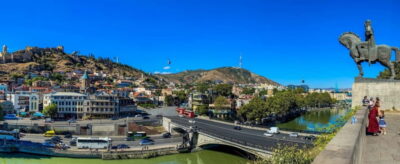
Evening Walking & Talking Tour with Wine & Boat Ride
Read our review →
Evening Walking Tour with Wine & Boat Ride Options
Read our review →
Old Tbilisi Highlights walking tour with wine & 10 tastings
Read our review →
Old Tbilisi Tour: Private Walking Tour With Wine Tasting
Read our review →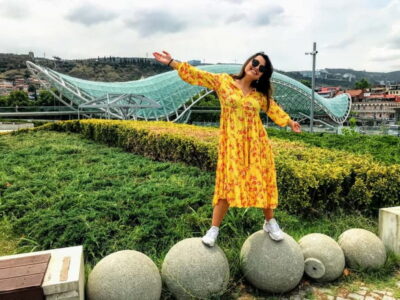
Private Tbilisi Food Tour: 9 Tastings Walk in Bohemian District
Read our review →Browse the lists this tour appears in