

Reviewed · WINE TOURS
Very Friendly Tbilisi Walking Tour (wine tasting & cable car)
Small-group friendliness makes Tbilisi click fast. This tour strings together the right mix of old streets, standout monuments, and a cable car ride, so you get oriented quickly without feeling rushed. What I like most is the personal size (maximum 15) paired with free-entry stops across the old town highlights.
The other big win is the guide approachability. One highlighted guide is Anastasia from Fellini Travels, described as very friendly and close, which makes the 4 hours feel easy to handle. My only caution: each stop is brief, so if you want long hangs inside churches or deep questions at every corner, you may crave extra time after the tour.
In This Review
- Key things to know before you go
- A 4-hour Tbilisi loop that balances must-sees and surprises
- Stop-by-stop: what each part is really for
- 1) Tbilisi Wall Ruins, Old Customs Gate vibe (about 15 minutes)
- 2) Rezo Gabriadze Marionette Theater, the once-an-hour angel (about 15 minutes)
- 3) Anchiskhati Basilica, the 6th-century anchor (about 10 minutes)
- 4) Patriarchate of Georgia seminary building area (about 10 minutes)
- 5) Bridge of Peace (about 15 minutes)
- 6) Rike Park, the Georgia-shaped layout (about 15 minutes)
- 7) Metekhi Cathedral, St. Shushanik’s tomb (about 15 minutes)
- 8) Monument of King Vakhtang Gorgasali (about 5 minutes)
- 9) Aerial Tramway to Narikala fortress (about 10 minutes, included)
- 10) Kartlis Deda, the Mother of Kartli statue (about 10 minutes)
- 11) Narikala Fortress fragments, including St. Nicolas temple (about 20 minutes)
- 12) Juma Mosque, the only Muslim shrine in the city (below Narikala)
- 13) Leghvtakhevi Waterfall, 22 meters and fig origins (about 10 minutes)
- 14) Abanotubani sulphur baths district (about 30 minutes)
- 15) Chreli Abano, a sulphur bath that looks like a mosque (short stop)
- 16) Meidan Bazaar, a central shopping square with old names (about 20 minutes)
- 17) Shardeni Street, named after Jean Chardin (about 10 minutes)
- 18) Sioni Cathedral Church, from the 5th century to today (about 10 minutes)
- Price and value: where your $27.24 really goes
- The cable car and Narikala moment: the best payoff for most people
- Who should book this walking tour, and who should skip it
- Should you book the Very Friendly Tbilisi Walking Tour (wine tasting & cable car)?
- FAQ
- What is the duration of the tour?
- How much does the tour cost?
- Is the Narikala cable car included?
- Are tickets included for the stops?
- Is bottled water included?
- Where do I meet the tour?
- Where does the tour end?
- Does the tour include hotel pickup?
- How big is the group?
- Can I cancel and get a full refund?
Key things to know before you go
- Max 15 people keeps the walk from turning into a herd.
- Cable car included for the Narikala fortress viewpoint.
- Most admissions listed as free, which helps the value side a lot.
- Focus on Old Tbilisi landmarks from church to baths to bridges.
- Bottled water included, useful in a long walk.
More Wine Tours in Tbilisi
- Day Trip to Kakheti Wine Region Including 9 Wine Tastings★ 5.0 · 2,774 reviews
- From Tbilisi: Kakheti Wine Region Tour with 9 Wine Tastings★ 4.9 · 2,541 reviews
- Tbilisi: Kakheti Wine Region Tour with 10 Wine Tastings★ 5.0 · 2,160 reviews
- Tbilisi: Mtskheta Jvari Bazaar, Chronicles of Georgia & Wine★ 5.0 · 1,088 reviews
A 4-hour Tbilisi loop that balances must-sees and surprises
This is the kind of tour I recommend when you want structure in your first (or early) days in Tbilisi. You start at Tbilisi Pushkin Square and end near Orbeliani Bazaar, which is practical because you finish in an area where you can keep exploring on your own.
The route is built around a simple idea: you walk the historic spine, you pause at places that explain the city’s mix of eras and faiths, and you take one quick lift on the aerial tramway to reach Narikala fortress. It is not just photo stops either. The tour’s promise is to help you understand local life through your guide’s commentary, and the feedback we have points strongly to a friendly, warm guide style.
One more thing: the tour is labeled as very friendly, and the “feel” matches that. Anastasia from Fellini Travels is specifically mentioned as an excellent guide who is warm and close in the way she interacts. That matters, because Tbilisi has lots of small details packed into a small area, and a guide who chats easily helps you catch them.
Stop-by-stop: what each part is really for
Below is how the day flows, and what each moment is best at.
1) Tbilisi Wall Ruins, Old Customs Gate vibe (about 15 minutes)
You begin with the city wall ruins and the underground heritage connected to the 11th century Old customs gate. This is a good start because it frames Tbilisi as a city shaped by passage and protection, not only by its modern bridges.
Why it works for you: early context. You get a sense of the city’s older boundaries before you start moving through the old core.
What to watch: the time is short, so keep your camera ready but also listen for the “why this matters” part from your guide.
2) Rezo Gabriadze Marionette Theater, the once-an-hour angel (about 15 minutes)
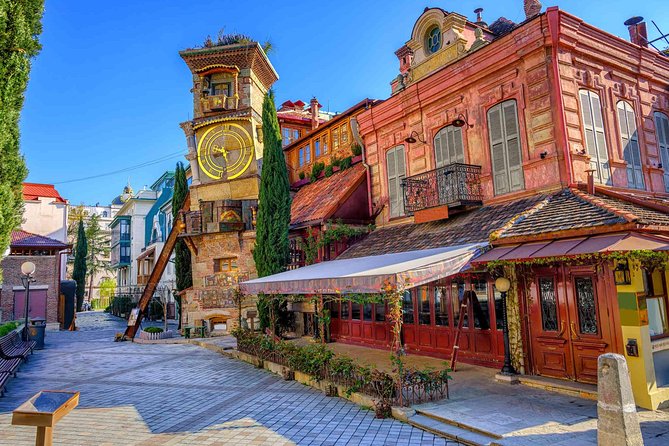
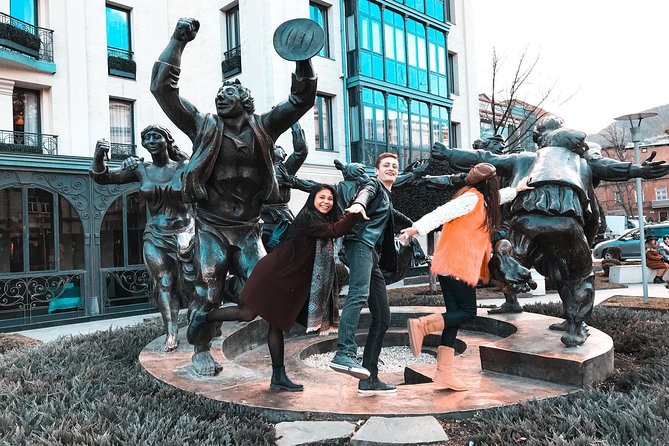
Next is Rezo Gabriadze’s puppet theater, known for the golden angel that comes out of a painted doorway and rings a bell with a small hammer once an hour. The theater was built in 1981, and the clock tower feature added in 2010 has become a signature.
Why it works for you: it is one of those “only in Tbilisi” details that turns a stop into a memory. The hourly angel moment is the kind of specific detail that makes the city feel alive.
What to watch: plan for timing. If you miss the bell cycle, you still see the architecture and the theater, but you might not catch the exact moment.
Still around Tbilisi? These come up often:

3) Anchiskhati Basilica, the 6th-century anchor (about 10 minutes)
Anchiskhati Cathedral is a three-nave basilica from the 6th century, described as the oldest church building in Tbilisi. It also ties into Georgian religious art through the icon of the Savior brought in 1664, with a note that this icon is kept in the Georgian National Museum.
Why it works for you: the stop gives you a concrete timeline point. A 6th-century anchor changes how you read the rest of the religious sites later.
What to watch: like many old-town church stops, it is quick. If you like to study icons, you may want extra time after the tour.
4) Patriarchate of Georgia seminary building area (about 10 minutes)
You pass by the Patriarchate of Georgia site on Erekle II Square. The current building began in 1809 on ruins connected to a palace area, and it later became part of the Russian Orthodox Church structure.
Why it works for you: it shows the layer-cake nature of the city. The same space can shift function across centuries.
What to watch: this one is more of a “see and understand the location” stop than a long visit.
5) Bridge of Peace (about 15 minutes)
Then you reach the Peace Bridge, officially opened May 6, 2010. It connects Erekle II Street and Rike across the Mtkvari River. The details here are nice: architect Michele de Luca, and lighting designer Philippe Martino.
Why it works for you: it is a smooth transition from old stone to a modern symbol of renewed Tbilisi, with enough design specifics to make it more than a crossing.
What to watch: if it is bright, you will likely catch reflections from the river. Bring sunglasses if you get glare.
6) Rike Park, the Georgia-shaped layout (about 15 minutes)
Rike Park is described as an artistically appointed park that, from above, forms a large-scale map of Georgia. Its pathways are said to depict regions.
Why it works for you: it is an easy breather. You get a view and a mental map of the country while staying right in the city center.
What to watch: parks can be windy and exposed. If you are sensitive to weather, carry a light layer.
7) Metekhi Cathedral, St. Shushanik’s tomb (about 15 minutes)
Metekhi Church of the Nativity of the Virgin Mary centers on the tomb of St. Shushanik. The description includes a split between Armenians and Georgians at the beginning of the 7th century, and how Catholicos Kyrion transferred the remains to this temple. It also notes that Queen Tamar adorned the body with gilded clothes.
Why it works for you: it ties a single sacred story to a specific location. It makes the building feel purposeful, not just old.
What to watch: again, short stop time. If you enjoy tracing names and saints, jot them down so you can remember them later.
8) Monument of King Vakhtang Gorgasali (about 5 minutes)
This is a quick moment with King Vakhtang Gorgasali, known as a king of Iberia, Kartli. The note says the dates of Vakhtang’s reign are problematic, and it references alliance with the Byzantine Empire and conflict against Sasanian Iranian hegemony.
Why it works for you: it plants another political timeline marker so the city story feels connected instead of scattered.
What to watch: five minutes is just enough to read and absorb, not enough to go deep.
9) Aerial Tramway to Narikala fortress (about 10 minutes, included)
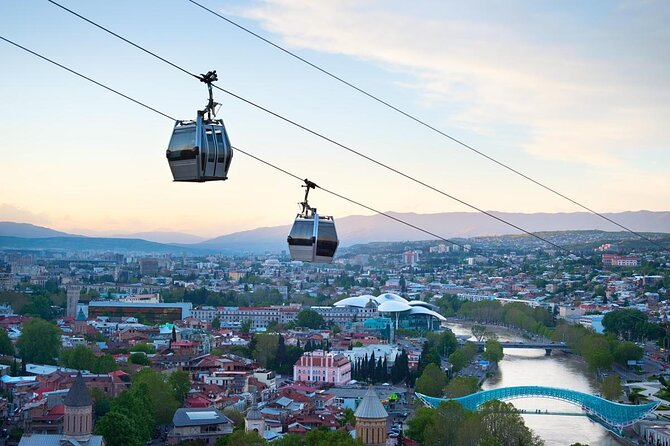
Now you do the cable car connection between Rike Park (Europe Square) and the Narikala fortress area. This is one of the best value adds because it is explicitly included.
Why it works for you: it reduces the walking strain and gives you a change of perspective fast.
What to watch: if you are afraid of heights, keep that in mind. Otherwise, it is a simple way to reach the fortress area without turning the whole tour into steep uphill legs.
10) Kartlis Deda, the Mother of Kartli statue (about 10 minutes)
Kartlis Deda, or Mother of Kartli, is described as a symbol of Georgian national character. The statue holds a wine glass for guests in one hand and a sword for enemies in the other.
Why it works for you: it is symbolism you can actually interpret in the moment, and it sets up why wine and hospitality show up in how the city presents itself.
What to watch: it is a viewing stop. If you want long photo sessions, you will have to move quickly with the group.
11) Narikala Fortress fragments, including St. Nicolas temple (about 20 minutes)
Narikala fortress is on the Holy Mountain Mtatsminda, with fragments dating back to the 4th century AD. The description notes expansions in later periods, including Arab fortification work in the 7th to 8th centuries. The fortress territory includes St. Nicolas temple dated to the 12th century.
Why it works for you: it is the “big view” payoff part of the route, plus a strong time span in one place.
What to watch: you are on a fortress site. Expect uneven ground and some walking from spot to spot.
12) Juma Mosque, the only Muslim shrine in the city (below Narikala)
You also pass by the Juma Mosque in Old Tbilisi, described as currently the only Muslim shrine in the city. It notes Ottoman construction in 1723 to 1735, destruction by Persians in the 1740s, rebuilding by Giovanni Scudieri between 1846 and 1851, and later renovations in 1895 by Hajizinelabdin Tagiyev.
Why it works for you: it highlights Tbilisi’s religious mix in a very concrete way, and the timeline here is unusually detailed.
What to watch: this stop is listed without a time estimate in the provided flow, so it will likely fit into the schedule pacing near the fortress area.
13) Leghvtakhevi Waterfall, 22 meters and fig origins (about 10 minutes)
Leghvtakhevi waterfall is listed as 22 meters tall and located in the old city near an ancient Abanotubani area. The name comes from Georgian “leghvi” meaning fig, and it notes there were fig trees around.
Why it works for you: it is a rare “nature within the city” stop that breaks up the stone-and-church rhythm.
What to watch: water sites can be damp. Wear shoes you are happy to get a little wet from splashes.
14) Abanotubani sulphur baths district (about 30 minutes)
Abanotubani is famous for sulphur baths, with hot sulphur springs said to have promoted the baths. The info notes baths built across about the 17th to 19th centuries, and mentions the oldest Irakli bath tied to ownership arguments between the imperial family and Georgian princes in the 16th century.
Why it works for you: you get the city’s living tradition. Even if you do not go into a bath, you learn what the area is for.
What to watch: your time is limited to a district stop. If you want to actually soak, you would need extra time outside the tour.
15) Chreli Abano, a sulphur bath that looks like a mosque (short stop)
Chreli Abano is listed as a popular sulphur bath that looks like a mosque, with a note that it is nice to visit and have fun.
Why it works for you: it is a playful contrast, and it helps explain why Abanotubani has that iconic look.
What to watch: a bath visit is not included in the tour cost, and food and drinks are not included either, so plan on this being a look-and-decide moment.
16) Meidan Bazaar, a central shopping square with old names (about 20 minutes)
Then you arrive at Meidan Bazaar, a commercial square noted as mentioned by French traveler Jean Sharden in the 18th century. The description lists earlier names like Shaitan Bazaar and Tsikhis Moedani. It is positioned as the place to buy traditional Georgian wine, handmade accessories, souvenirs, and delicacies.
Why it works for you: it’s the practical part where you can pick up gifts, taste with your own choices if you want, and connect the tour themes to local commerce.
What to watch: the tour does not include food and drinks, so treat any tasting as something you would pay for on your own unless your guide confirms otherwise.
17) Shardeni Street, named after Jean Chardin (about 10 minutes)
Shardeni Street is a pedestrian street lined with cafes and galleries, and the reconstruction in the 19th century is said to have led to the street being named after Jean Chardin.
Why it works for you: it is a good “walk it off” stretch where the old city feels social and present-day.
What to watch: you will likely get a lot of smells and music from nearby cafes. If crowds bother you, keep moving with the group.
18) Sioni Cathedral Church, from the 5th century to today (about 10 minutes)
Finally, you reach Sioni Cathedral of the Assumption of the Blessed Virgin Mary. It is described as a cross-domed temple located on the lower right bank of the Mtkvari in Old Tbilisi, with a 5th-century origin and ongoing status up to the present. The description also notes that since 1920 it became the Patriarchal Cathedral.
Why it works for you: it is a strong closing stop with a long timeline, and a satisfying visual end to the religious-and-cultural focus of the route.
What to watch: if you are tired, keep it simple here. The group stop is short, so focus on the exterior and key details your guide points out.
Price and value: where your $27.24 really goes
At $27.24 per person, this tour is priced like a budget-friendly orientation walk with one paid “premium” element. Here is why.
- You get a local guide and bottled water included.
- The schedule includes many stops with free admission listed across the main sights.
- The aerial tramway ticket is included, connecting Rike Park to Narikala.
The tradeoff is that most stops are short, around 5 to 20 minutes. That is not a bad thing, but it changes your expectations. You are not buying hours of slow museum-style wandering. You are buying a guided route that helps you understand what you are seeing quickly, then gives you a place to continue afterward near Orbeliani Bazaar.
Food and drinks are not included, and that also affects how you should think about the tour name hinting at wine tasting. If tasting samples are part of your specific date, your guide will need to confirm it. Otherwise, plan to buy or try things yourself on Meidan Bazaar or nearby streets.
The cable car and Narikala moment: the best payoff for most people
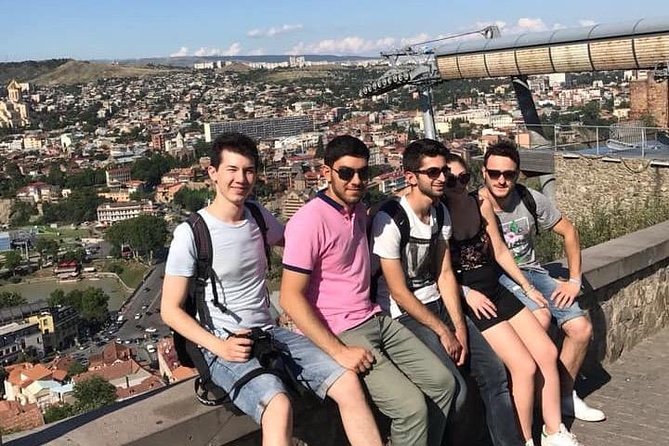
If you only care about one “special moment,” make it the tramway to Narikala. It is the one included ticket you get, and it reshapes the feel of the tour because you go from riverside walking to a fortress viewpoint.
Narikala itself spans a huge time range in the description, with fragments from the 4th century AD and later Arab fortification work in the 7th to 8th centuries, plus St. Nicolas temple dated to the 12th century. Even if you are not a history nerd, that time layering gives you a better mental picture of why the fortress site matters.
Just remember: fortress areas are often uneven. Wear shoes you can walk in comfortably, and expect the walking to be real even if each stop is brief.
Who should book this walking tour, and who should skip it

This tour is a great fit if you want:
- A structured way to see major Old Tbilisi landmarks in about 4 hours.
- A small group experience (maximum 15).
- A guide-forward approach where friendliness helps you understand the city quickly.
- A route that ends in a lively area near Orbeliani Bazaar so you can keep exploring.
You might want a different option if you:
- Prefer long, in-depth time inside fewer sites.
- Want food included as part of a wine tasting experience, since food and drinks are not included.
- Need a very slow pace throughout, since the stop times are short across many locations.
Should you book the Very Friendly Tbilisi Walking Tour (wine tasting & cable car)?

If you are heading to Tbilisi for a first time, or you have only a half day and want strong orientation, I’d book it. The value math is solid because the cable car is included, water is included, and most admissions are listed as free. The “very friendly” part is not marketing fluff here either, because Anastasia from Fellini Travels is specifically praised for warmth and close, easy interaction.
My call hinges on one practical check. Because food and drinks are not included, and the title mentions wine tasting, confirm ahead of time whether any tasting samples are actually part of your departure. If it is confirmed, you get both the walking story and the flavors. If not, you still get a smart guided route plus easy opportunities to pick up Georgian items at Meidan Bazaar and keep going on your own after the tour ends near Orbeliani.
FAQ
What is the duration of the tour?
The tour lasts about 4 hours.
How much does the tour cost?
The price is $27.24 per person.
Is the Narikala cable car included?
Yes. The aerial tramway in Tbilisi is listed as included.
Are tickets included for the stops?
Most stops list admission tickets as free, and the cable car is included. The provided details say food and drinks are not included.
Is bottled water included?
Yes, bottled water is included.
Where do I meet the tour?
The start point is Tbilisi Pushkin Square, Tbilisi, Georgia.
Where does the tour end?
The tour ends at Площадь Орбелиани (Orbeliani Square) near Orbeliani Bazaar.
Does the tour include hotel pickup?
The highlights say hotel pickup is available, but the “not included” section lists hotel pickup and drop-off. Confirm the exact pickup details when booking.
How big is the group?
It is described as a small-group tour with a maximum of 15. The activity info also lists a maximum of 100 travelers.
Can I cancel and get a full refund?
Yes. Free cancellation is available, and you can cancel up to 24 hours in advance for a full refund.
More Walking Tours in Tbilisi
- Tbilisi Walking Tour Including Cable Car and Traditional Bakery
★ 5.0 · 1,310 reviews - Tbilisi: City Highlights Guided Walking Tour
★ 4.9 · 1,114 reviews - Tbilisi:Evening Walking & Talking Tour with Wine & Boat Ride
★ 5.0 · 572 reviews - Tbilisi: Evening Walking Tour with Wine & Boat Ride Options
★ 5.0 · 407 reviews
Other Food Tours in Tbilisi
- Tbilisi:Mtskheta,Jvari,Bazaar,wine tasting,Chronicles of Georgia
★ 5.0 · 730 reviews - Old Tbilisi Tour: Private Walking Tour With Wine Tasting
★ 5.0 · 273 reviews - Private Tbilisi Food Tour: 9 Tastings Walk in Bohemian District
★ 5.0 · 227 reviews - Tbilisi Food Tour in a Local Family
★ 5.0 · 113 reviews
Newer trips around Tbilisi
- Tbilisi Private Dinner: Georgian BBQ & Fireplace
★ 5.0 · 1 review - Tbilisi: Khinkali Tasting Lunch with Local Drinks and Pickup
★ 5.0 · 1 review - Day trip in Kakheti-wine tour
★ 5.0 · 1 review - Tbilisi & Mtskheta bus tour hop on hop off
★ 5.0 · 1 review - Tbilisi: Christmas Market & Hidden Gems Guided Walking Tour
★ 5.0 · 1 review - Stalin’s Secrets: An Underground Journey Through History
★ 5.0 · 1 review
Wine Tours, compared.
Day Trip to Kakheti Wine Region Including 9 Wine Tastings
Read our review →
Kakheti Wine Region Tour with 9 Wine Tastings
Read our review →
Kakheti Wine Region Tour with 10 Wine Tastings
Read our review →
Mtskheta Jvari Bazaar, Chronicles of Georgia & Wine
Read our review →
Kakheti Wine Region: Signagi and Bodbe Tour with 10 Wine Tastings
Read our review →
Mtskheta,Jvari,Bazaar,wine tasting,Chronicles of Georgia
Read our review →
Evening Walking & Talking Tour with Wine & Boat Ride
Read our review →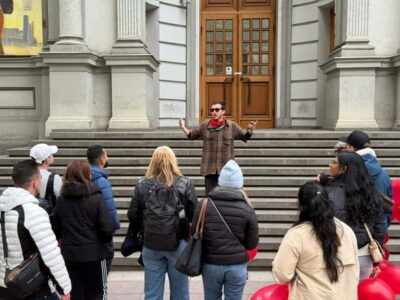
Evening Walking Tour with Wine & Boat Ride Options
Read our review →Browse the lists this tour appears in